
Fragrant Flowers Container Plants Blooming Gifts
Specials
Search by Growing Zone

Canna Lily Growing Information


Not for the Timid

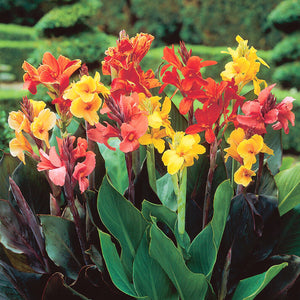
If wearing bright colors makes you uncomfortable, cannas may not be for you.  If, however, you like mixing bright pink tops with teal bottoms, these plants are going to provide many seasons of fun.


Canna lilies have leaves that fall into the "large" to "huge" range and flowers that follow suit.  Site these horticultural Titans wherever moderate size shrubs would do, but would simple be too tame.  As warm climate foundation plantings, along property lines lieu of fences and at the edges of ponds, reflected in the bright waters.


Experiment with a few cannas and let your imagination go.  Don't be timid.


Outdoor Beds

1.  Find a location where the soil drains well.  If there are still water puddles 5-6 hours after a hard rain, scout out another site.  Or amend the soil with the addition of organic material to raise the level 2-3 inches to improve the drainage.  Peat moss, compost, ground bark or decomposed manure all work well and are widely available. Canna lilies can thrive in soils that are too moist for many bulbs, but the soil must not be water logged.


2. Site your canna lilies where they will receive full sunlight. 


3. Dig holes and plant the rhizomes 4"-6" deep, and 2 feet apart for tall varieties or 1 foot apart for the medium to dwarf types.  Place the rhizomes with the eyes facing up. 


4.  After planting, water your cannas generously, soaking the soil.  Roots and sprouts will form quickly in warm soil.  (If the soil is still quite cool, wait until it warms before planting.) 


5.  When in bloom, feel free to cut canna lily flowers for bouquets.  Some gardeners grow the varieties with deeply colored or striped leaves for the foliage only and cut off all the flowers.  If you prefer this approach, it will not hurt the plants to be pruned this way.


6.  After blooming has finished for the season leave the foliage in place; don't cut it off.  The leaves will gather sunlight and provide nourishment for next year's show. Water as needed.  Leaves may be removed when they yellow. (In cold areas, to save your canna rhizomes for next year, dig them after the first frost.  Let the rhizomes air dry for several days. Then store in a cool location in paper bags or boxes filled with peat moss. While this approach doesn't always work because holding temperature and moisture level of rhizomes and storage medium must be fairly exact to please these tropical plants, if you're an adventurous gardener, it's worth a try.)


7.  Your cannas will rest for a few months before beginning the next growing cycle.


Pots, Tubs & Urns

1.  Fill your containers with good quality, well-drained soil.  Almost any commercially available potting medium will work fine.  Make sure there are adequate drainage holes; canna tubers must never sit in waterlogged soil or they will rot.  Keep in mind the mature size of the varieties you have chosen and plan your container sizes accordingly.


2.  Site containers where they will receive full sun. 


3. Dig holes and plant the rhizomes 4"-6" deep, and 15"-18" apart for tall varieties or 10"-12" apart for the medium to dwarf types.  Place the rhizomes with the eyes facing up. 


4.  After planting, water your cannas generously, soaking the soil.  Roots and sprouts will form quickly in warm soil.  (If the soil is still quite cool, wait until it warms before planting.) 


5.  When in bloom, feel free to cut canna lily flowers for bouquets.  Some gardeners grow the varieties with deeply colored or striped leaves for the foliage only and cut off all the flowers.  If you prefer this approach, it will not hurt the plants to be pruned this way.


6.  After blooming has finished for the season leave the foliage in place; don't cut it off.  The leaves will gather sunlight and provide nourishment for next year's show.  Water as needed.   Leaves may be removed when they yellow.  (In cold areas, to save your canna rhizomes for next year, dig them after the first frost. Let the rhizomes air dry for several days. Then store in a cool location in paper bags or boxes filled with peat moss. While this approach doesn't always work because holding temperature and moisture level of rhizomes and storage medium must be fairly exact to please these tropical plants, if you're an adventurous gardener, it's worth a try.)


7.  Your cannas will rest for a few months before beginning the next growing cycle.


Browse All Products     Call Toll Free 1-866-725-5361  (or 760-754-0438)    Questions? Contact Easy to Grow Bulbs